



.png)


How to Use AI to Write a Resume That Actually Gets Interviews
If you want to use AI to write a resume effectively, the order matters. Many job seekers begin with ChatGPT resume prompts or generic AI resume builder tools. Those tools improve wording and formatting.
But before refining language, your resume needs to be built around two things:
- Your natural work personality strengths
- The strengths required for success in the career you are targeting
CareerFitter is designed to solve that first step.
Through the CareerFitter assessment, your validated work personality strengths are identified. Through CareerFitter’s career database, the required strengths for success in a specific job or career are defined. Where those two overlap is where your strongest positioning exists.
The Career-Targeted Resume Tool by CareerFitter allows you to select that overlap and organically infuse that strength-based terminology into your resume. The result is a resume that speaks the language hiring professionals are looking for in that role.
After that foundation is built, AI tools like ChatGPT can be used to refine wording and improve formatting. But the strength alignment must come first.
Start the process with the career test trusted for over 25 years: Career Test by CareerFitter.
Why Alignment Comes Before AI Refinement
If you paste your resume into ChatGPT and ask it to improve it, the tool will clean up your wording. It may tighten bullet points, correct grammar, and reorganize sections.
That improvement is valuable, but it is surface-level. AI does not independently determine:
- Which specific career your resume should clearly support
- Which strengths are most critical for success in that career
- Which of your natural personality strengths overlap with those required strengths
- Which terminology hiring professionals expect to see when evaluating candidates in that field
AI works with the content you provide. If your resume is not clearly aligned to a defined career and infused with the strengths that matter most in that profession, AI will simply make a misaligned resume sound more polished.
This is the step most job seekers skip.
Before rewriting your resume, you need clarity on two things:
- The career you are targeting
- The natural strengths that align with that career
Most job seekers apply broadly and adjust keywords for each posting. They never define how their natural strengths overlap with the core strengths required in a specific career.
When you skip alignment, your resume becomes reactive. You chase job descriptions instead of presenting a consistent professional identity.
A targeted resume is built around:
- Your validated natural strengths
- The strengths required in your chosen career
- The language and strength signals hiring professionals expect
Generic AI tools cannot determine that overlap because they do not have access to your validated work personality strengths and how they map to a specific career.
Alignment is the first step. AI refinement is the second.
How the CareerFitter Career-Targeted Resume Tool Works
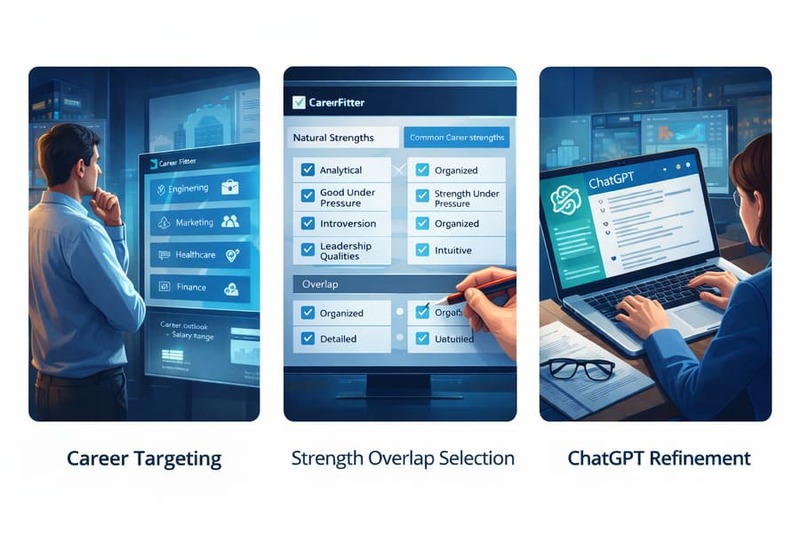
1. Complete Your CareerFitter Assessment
The resume tool is powered by your CareerFitter assessment results. That assessment identifies your natural personality strengths and work tendencies. These are not guessed from a prompt. They are derived from validated assessment data.
Those strengths become the foundation of your resume positioning.
If you want a quick refresher on standard resume structure and formatting expectations, Harvard’s guide is a reliable reference: Harvard College Guide to Resumes & Cover Letters.
2. Choose the Career You Want to Target
Next, you select the career you want your resume to target. CareerFitter will suggest matching careers based on your results, and you can also target any career you have marked as a favorite. You are no longer writing a general resume.
Each career has common strength patterns associated with success in that role. CareerFitter includes data across 1,000+ careers.
3. Confirm and Select the Overlapping Natural Strengths
The tool automatically displays your natural strengths from your CareerFitter assessment as pre-selected. It also shows the strengths commonly required for success in your chosen career.
This gives you visibility into two things at once:
- The strengths you naturally possess
- The strengths typically associated with success in that career
You can then confirm the overlap and optionally select additional career-required strengths that you genuinely possess but may not have been highlighted as strongly in your results.
4. Paste Your Existing Resume
Now, you paste your current resume text into the CareerFitter Career-Targeted Resume Tool.
It enhances it, restructures it, and regenerates it to reflect where your work personality strengths and the required strengths of the career overlap.
5. Generate a Career-Targeted Resume
The CareerFitter Career-Targeted Resume Tool then regenerates your complete resume. It infuses your natural strengths into every possible area of your resume. It aligns your wording with the selected career and integrates terminology that reflects both your personality strengths and the expectations of that field.
The result is not a generic rewrite. It is a strategically aligned resume that reflects:
- Your validated natural strengths
- The strength profile of your chosen career
- Language consistent with hiring expectations
This tool is built to optimize your resume content. It ensures your resume reflects the correct strengths and aligns with your chosen career. It does a solid job with formatting, but formatting is not its primary purpose.
If you want more advanced visual formatting, layout customization, or design refinement, take the regenerated resume content and paste it into ChatGPT or another professional resume formatting service.
The correct sequence is: use CareerFitter to generate aligned content first, then use AI or another tool to refine layout and presentation.
How to Use ChatGPT the Right Way After CareerFitter
Once your resume content has been strategically aligned using the CareerFitter Career-Targeted Resume Tool, ChatGPT becomes far more effective.
At this stage, you are not asking AI to define who you are professionally. You are asking it to refine and enhance content that is already aligned.
Use ChatGPT for the following:
- Tightening long bullet points
- Making language more concise
- Adjusting tone to be more formal or direct
- Improving readability
- Creating a customized cover letter based on your finalized resume
Avoid using ChatGPT to:
- Invent strengths that are not validated by your assessment
- Guess which career you should target
- Replace strategic positioning decisions
Here are examples of prompts you can use after generating your CareerFitter resume content.
Prompt 1: Tighten Bullet Points
Rewrite the following resume bullet points to be more concise and results-focused without changing the meaning. Keep the tone professional and direct.
(Paste your bullet points below the prompt.)
Prompt 2: Improve Professional Summary
Refine this professional summary to sound confident, concise, and aligned with a [target job title]. Do not add new achievements or strengths. Only improve clarity and flow.
(Paste your summary below the prompt.)
Prompt 3: Generate a Targeted Cover Letter
Using the resume content below, write a professional cover letter tailored to the following job description. Keep it under 400 words and maintain a clear, confident tone.
(Paste your resume content and job description below the prompt.)
When strategy comes first and AI refinement comes second, the result is consistent and credible positioning.
Why Strength Alignment Improves ATS and Human Screening

Applicant Tracking Systems (ATS) and AI screening tools are designed to detect relevance and consistency. They evaluate whether your experience, skills, and language align with the job requirements. Human reviewers then assess credibility and coherence.
It is hard to give one universal percentage for how much a career-targeted resume increases interview chances because results vary by role, industry, and applicant quality. But high-quality research does show that targeted, clearly written application materials measurably improve outcomes.
- Harvard’s resume guidance recommends tailoring your resume to the type of position you are seeking, which helps keep your content focused and relevant to what employers review. Harvard FAS: Create a Strong Resume
- In a large field experiment in an online labor market, researchers found that providing algorithmic writing assistance on resumes increased the probability of being hired by about 8% in the first month on the platform.
These sources support a practical conclusion: clearer, better-targeted materials improve outcomes, even though the exact interview lift varies by role and market.
A resume infused with your validated natural strengths and aligned to a specific career creates coherence. Your summary, bullet points, and overall tone reinforce the same underlying strengths. That consistency supports:
- Relevance signals for automated screening systems
- Credibility for hiring professionals
Strength alignment does not mean exaggerating traits or inserting buzzwords. It means presenting your experience through a lens that accurately reflects how you naturally operate and how that matches the expectations of the role.
When your resume demonstrates a clear overlap between your natural strengths and the career you are targeting, it becomes easier for both software and hiring professionals to see you as a logical fit.
A Simple Workflow You Can Follow Today
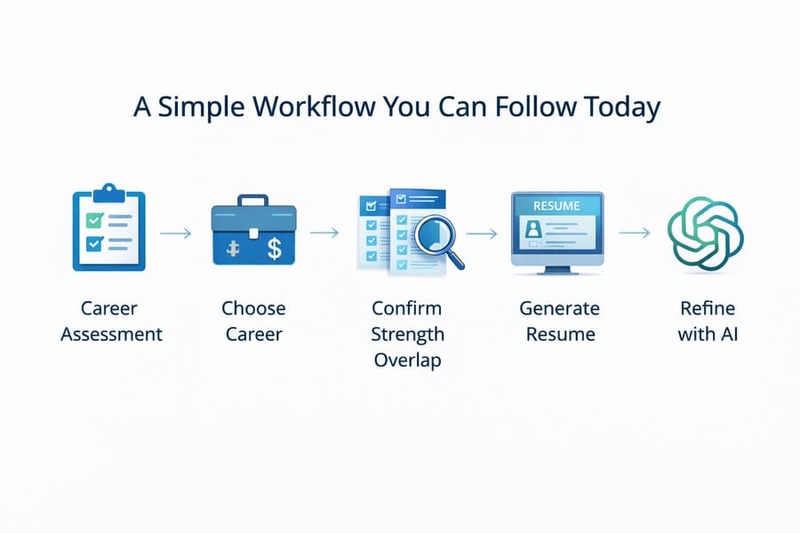
- Complete the CareerFitter assessment to identify your natural strengths.
- Choose the career you want to target using CareerFitter recommendations and research tools.
- Confirm the overlap between your strengths and career-required strengths.
- Paste your existing resume and regenerate a career-targeted version.
- Use Chat GPT or another tool to refine formatting and polish language.
If you want to begin the process now, start with the career personality assessment: The Career Test by CareerFitter.





.avif)


